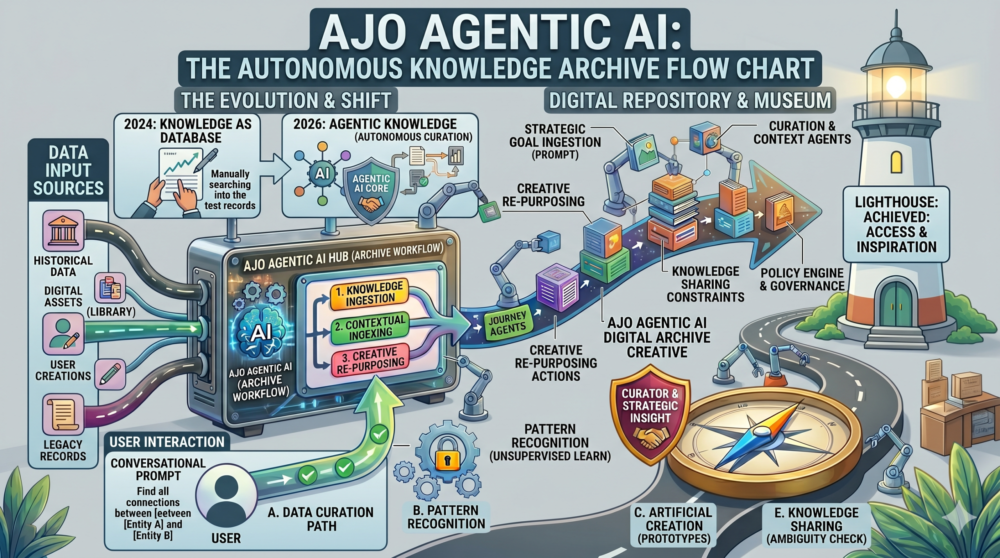
It’s 2026, and the term “AI” has evolved. In 2024, AI meant an assistant that could help generate an email subject line or rephrase a paragraph. By 2026, it is Agentic AI that dominates AJO journey design.
The difference is profound. Where early generative AI required a human to manually structure the logic and use the AI for small tasks, an Agentic AI system can take a high-level goal and, autonomously, act as an agent to achieve it.
The Role of the Journey Agent
In AJO, this capability is manifested in the Journey Agent. A practitioner no longer starts with a blank canvas and a palette of activities. They start with a conversational prompt and a destination.
A marketing operations lead might tell the Journey Agent: “Design a win-back journey for profiles who abandoned their cart on mobile but have a high loyalty score, and prioritize a push message over email.”
The Journey Agent does not just provide a plan; it builds the journey canvas. It selects the correct Read Audience activity, inserts the Decisioning (filtering) steps to check the loyalty score, configures the Push action, and even adds the necessary wait logic.
Shifting the Marketing Ops Role
This fundamentally rewrites the “Marketing Ops” role. For decades, Ops has been about clicking buttons and verifying technical configurations. In 2026, this task is automated, leaving the operator with a new responsibility: strategic orchestration and exception handling.
The role of the practitioner is no longer to be the expert in the tool (e.g., how to configure a condition). The new role is to be the expert in the strategy (e.g., what is the optimal path for a win-back, and what are the boundaries the agent should follow?). Humans must still define the guardrails and business rules, but the execution and construction are now in the hands of the agents. Those who resist this shift will find their workflow to be impossibly slow compared to the agent-driven competition.