
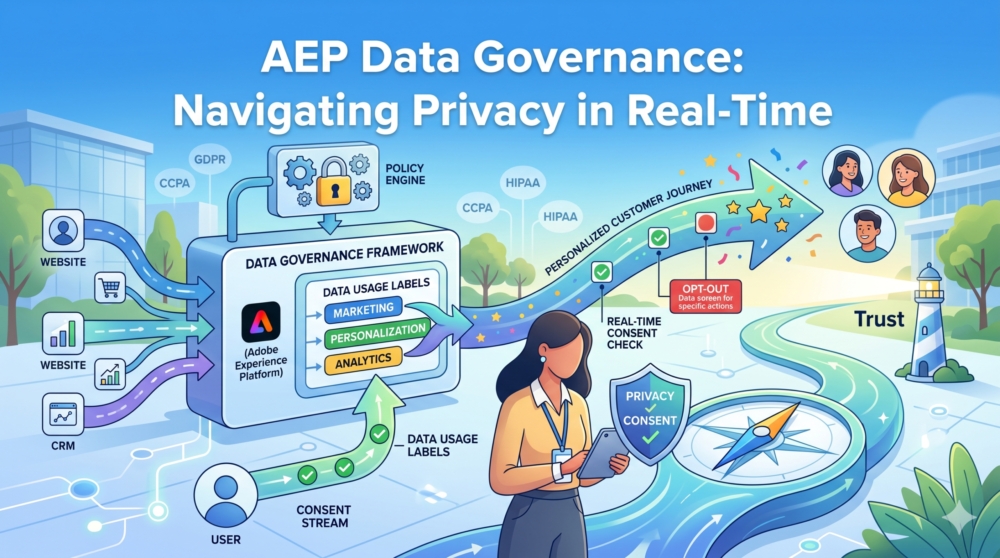
Privacy isn’t just a regulatory requirement; it’s a cornerstone of trust with your customers. This year, more than ever, safeguarding customer data is paramount. In this post, we’ll explore how to leverage Adobe Experience Platform (AEP) to build a data governance framework that automatically respects privacy and consent, even in real-time.
The Challenge of Consent in Real-Time
Imagine creating a personalized marketing journey. To be effective, you need to use customer data like browsing history, purchase behavior, and demographics. However, if a customer has opted out of specific types of communication or data usage (e.g., under GDPR or HIPAA), your journey needs to respect those preferences in real-time. Manually filtering out customers based on consent for every journey is time-consuming, error-prone, and doesn’t scale.
AEP Data Usage Labels and Policies: The Privacy Engine
AEP offers a powerful mechanism to automate consent compliance through Data Usage Labels and Policies. Here’s how it works:
-
Labeling Your Data: You assign descriptive labels to your datasets and specific attributes, indicating the intended use and restrictions. For example, you can label data as “Marketing,” “Analytics,” or “Personalization.”
-
Defining Policies: Policies are rules that determine how labeled data can be used. For instance, a policy might state that data labeled “Marketing” cannot be used for customers who have opted out of marketing communications.
-
Consent Management: Customers’ consent preferences are captured and stored in AEP. These preferences can be dynamically linked to their profiles.
-
Real-Time Enforcement: When a marketing journey triggers, AEP automatically checks the policies against the customer’s consent preferences. If a conflict exists (e.g., the journey uses data labeled “Marketing” for a customer who opted out), the journey is automatically blocked for that customer.
Key Benefits of AEP Data Governance
-
Automated Compliance: Ensure that all your journeys respect customer consent without manual intervention, reducing the risk of non-compliance.
-
Real-Time Protection: Privacy preferences are applied instantly, preventing any unauthorized use of data.
-
Centralized Management: Policies and labels are managed in one place, making it easy to update and scale your data governance framework.
-
Transparency: Gain clear visibility into how data is being used and who has accessed it, fostering trust with your customers.
-
Efficiency: Streamline your workflow by automating compliance checks, freeing up your team to focus on creating more engaging journeys.
Getting Started with AEP Data Governance
-
Define Your Privacy Requirements: Understand the specific data privacy regulations that apply to your business (e.g., GDPR, CCPA, HIPAA).
-
Catalog Your Data: Identify all your data sources and document the intended use for each dataset.
-
Assign Labels: Start labeling your data with relevant tags.
-
Develop Policies: Define the rules that govern how labeled data can be used based on customer consent.
-
Implement Consent Management: Connect your consent management platform to AEP to capture customer preferences.
-
Test and Monitor: Regularly test your policies to ensure they are working correctly and monitor data usage for any anomalies.
By implementing a robust AEP data governance framework, you can build trust with your customers and ensure that your real-time journeys are not only personalized but also privacy-compliant. This not only reduces the risk of costly regulatory penalties but also helps you cultivate long-lasting relationships with your customers based on respect for their privacy.